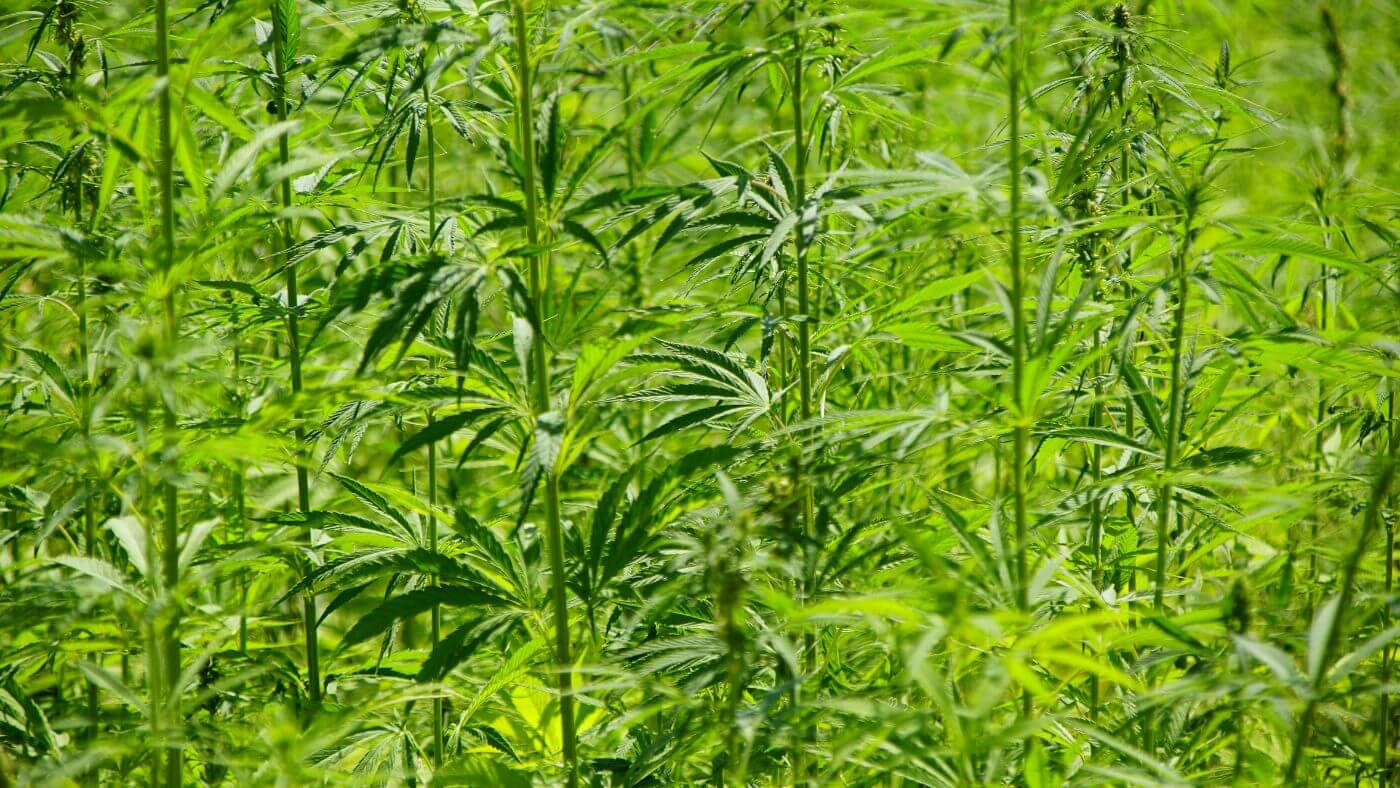
Biodegradable and durable, the hemp plant (cannabis sativa) has been cultivated for thousands of years because of its versatility and low environmental impact. Hemp plants are some of the world’s fastest-growing, making hemp a truly regenerative fibre.
Because it’s almost entirely impervious to pests, hemp can be grown without harmful chemicals such as organophosphates (a compound used in nerve gas and sheep dip). Also, unlike sheep’s fleece, hemp is naturally hypoallergenic, so no more itchy jumpers!
Hemp was once so important that King Henry VIII passed a law fining farmers who failed to grow the crop. Now, this miracle material is enjoying a renaissance. This is partly due to how green it is – hemp is entirely biodegradable, attracts a variety of pollinators, needs half as much water as conventional cotton, and carries a climate impact 42 times smaller than sheep’s wool (reared on sub-clover).
While producing one kilogram of sheep’s wool generates up to 89.1 kilograms of CO2 equivalent, one kilogram of hemp generates just 0.56 kilograms of CO2 equivalent.
Hemp also absorbs more CO2 than it emits. The European Commission suggests that one hectare of hemp sequesters as many as 15 tonnes of CO2, comparable to that stored by a young forest. In contrast, the animal-derived fibre industry produces an estimated 35 million tonnes of CO2 annually, and sheep contribute nearly 98%.
It’s not just carbon that hemp can absorb! It’s also capable of phytoremediation (purifying surrounding air and soil), and hemp plants have even helped rejuvenate thousands of acres of wasteland in Eastern Europe following the nuclear fallout of Chernobyl.
Hemp is also virtually waste-free; every part of the plant has market value. Hemp oil and seeds are common in food and beauty products, while the plant can be used in building products, paints, inks, paper, plastics, and even fuels.
Found in mildew, mould, and UV-resistant items, tweed, athletic wear, and so much more, strong, shrink-free hemp is a hero for our wardrobes, animals, and the environment. Many suppliers now provide hemp as an upgrade to environmentally intensive wool, and many designers, such as Hemp Fortex, are turning to the plant wool to create sustainable pieces. Hemp is soft and becomes even more so with each wash, making it a lifelong fibre. It’s no surprise that leading fashion houses including Valentino, Vivienne Westwood, and Maison Margiella are embracing this plant wool in their collections.
Read more: Discover Popular Plant Wools